Yerevan is the capital of Armenia. The first time I heard the name was when a journalist was reporting about the war involving Iran. Later, I realised that it made sense for Armenia to be so close to Iran, yet not actually be part of Iran. Armenia has four international borders, of which two are completely closed: Turkey to the west and Azerbaijan to the east. The borders with Georgia to the north and Iran to the south are open.
Mita, my wife, and I had flown from Delhi via Baku to Tbilisi in Georgia, from where we reached Yerevan by bus. The bus took us to the border, where we had to walk across the bridge dividing Georgia and Armenia. On the other side, another minibus was waiting to take us to Yerevan, the starting point of our journey through Armenia.
YerevanYerevan
Unlike previous trips, I had decided not to take my Pinarello with me, as we would be travelling through Turkey and beyond. In Yerevan, we therefore first looked for a reliable bike shop where I could rent a road bike for about ten days to cycle in the south, where the mountains particularly appealed to me.
As public transport is somewhat limited for reaching the places we wanted to visit, we had planned to rent a car for a few weeks. The idea was that I would drive in the north, while Mita would act as my support driver in the south.
As we were staying not too far from Republic Square, we found the bike shop Your Bike on 67 Hanrapetutyan Street. It soon became clear that road bikes are in very short supply in Armenia, something I would also discover in other countries. Fortunately, he did have a few road bikes, although they were clearly older models. Still, it would have to do.
He supplied a helmet and repair kit, and I asked for Shimano pedals so that I could use my own cycling shoes. The total cost for ten days was around €300 - not cheap, especially in a country with a relatively low cost of living.
Day 1 - Yeghegnadzor to Noravank Monastery 🚲
We spent the night in a B&B in Yeghegnadzor. It was on the outskirts of town and the hosts were very nice, although we needed Google Translate to communicate.
We gave Daniel, the Czech guest staying at the B&B, a lift to the main road, from where he planned to hitchhike north. I decided to use that location as my starting point, as the roads through town were extremely bad.
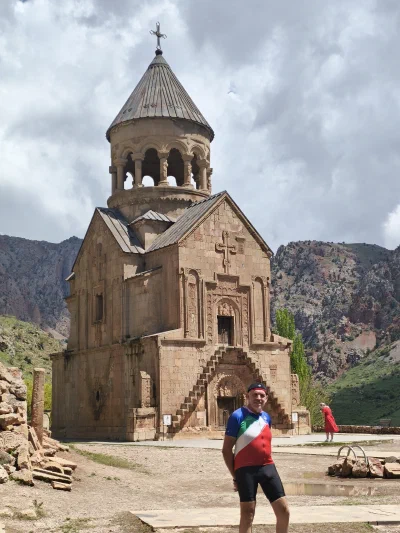
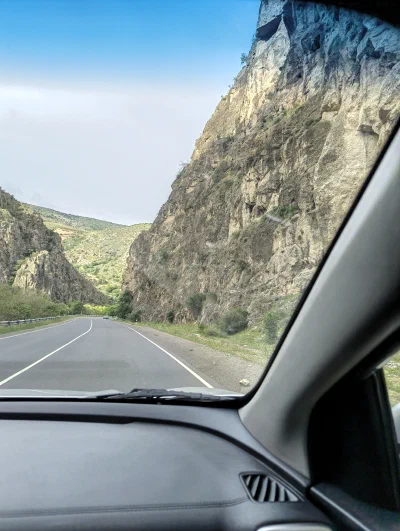
The bike wasn't great, but I had to make do with it. The largest rear sprocket had 28 teeth instead of the 34 on my Pinarello, which alone would make climbing considerably harder. To make matters worse, the pedals turned out to be Look rather than Shimano, so my cycling shoes stayed in the car.The Noravank MonasteryIt was only a 21 km ride to the turn-off for Noravank Monastery. The road takes you between dramatic red canyons, as if you have suddenly stepped into a postcard. Unforgettable were the three hairpin climbs, with gradients of up to 9%, needed to reach the monastery.
The peaceful atmosphere, stunning backdrop and detailed architecture made Noravank a great place to stop.
After a great lunch, however, the weather turned. Thunder and rain arrived, so I opted to return with Mita in the car. 😘
Day 2 - Smbataberd Castle 🚶
We decided to take a 'rest day' and drove to Smbataberd, a castle dating from between the 5th and 14th centuries.
Near the castle, some locals stopped us and told us that we could not drive any further and would have to take a taxi. We decided to walk instead. It was about 2.5 km to the fort, and the road was indeed barely a road anymore. It would have been a very challenging drive had we attempted it in our car.
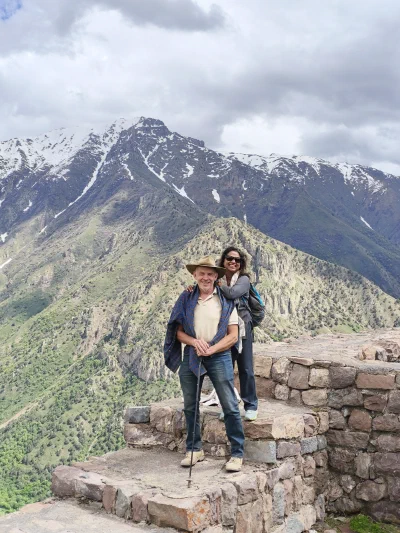
The surrounding mountains were stunning, and from the top we could see our car sitting a few hundred metres below us. We also noticed the thin air at altitude, which made us breathe surprisingly heavily.Smbataberd CastleEventually, the fort appeared in front of us. It sits on a narrow mountain ridge, with a canyon on three sides. Inside, the site is enormous - around six hectares - surrounded by walls that are at least two metres wide, wide enough for me to stand comfortably on top of them.
Eventually, we started the walk back down. I managed the initial section more or less on my backside, which was probably not the intended way to descend.
Less than halfway down, an old Lada stopped beside us. The driver gestured for us to get in. We were quite happy to continue walking, but he insisted, so we climbed in next to three young boys.
At the bottom, we thanked him and transferred ourselves back into the comfort of our KIA SUV.
Day 3 - Yeghegnadzor to Jermuk 🚲
We said goodbye to our lovely hosts and drove to the main road towards Jermuk. The roads through Yeghegnadzor were pretty atrocious, so we used the main road, which was also the best option for avoiding potholes.
We came across some roadworks, but fortunately that section wasn't too long.Yeghegnadzor to JermukMita drove the support vehicle, which made the ride much more relaxed. There was still plenty of climbing, though, from around 1,100 m to 2,100 m. The steepest sections were around 9%, while most of the climb ranged between 4 and 7%.
As we gained altitude, the weather became colder and cloudier. Luckily, I only had to put the bike in the car about 400 metres from our apartment in Jermuk, just before the rain arrived. 🌧️
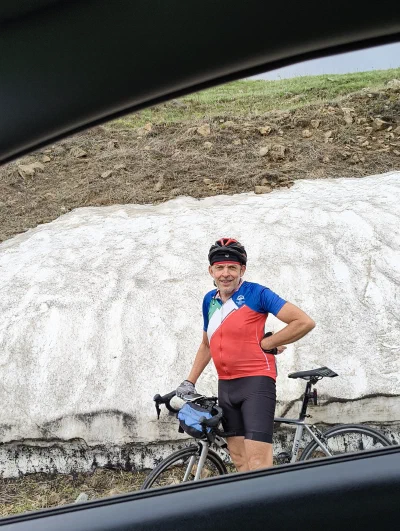
Jermuk has the feel of an alpine resort, with patches of snow still lying along the pavements in various places.
Mita insisted that I buy something warm, which turned out to be a very good idea considering I had brought only one long-sleeved shirt.
I also visited the barber to make myself look a little more presentable.
Dinner was good, although afterwards I still had to walk a kilometre through the rain to fetch the car and bring Majesty home.
Day 4 - To Goris 🚲
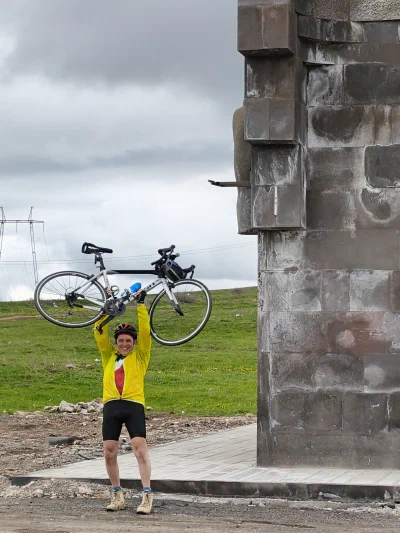
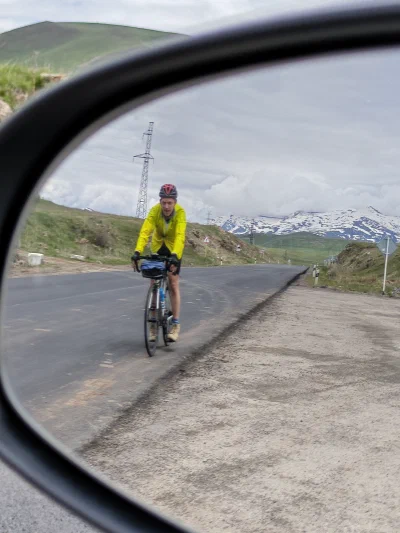
Today's ride included 1,726 metres of climbing. The highest point reached 2,330 metres, but the second climb felt every bit as challenging as the first.
The road became increasingly undulating, with sections of around 8%, and, as always, the finish seemed to keep moving further away the closer I got to it.
It was quite cold at the top, so I regularly pulled on my yellow wind jacket.
{{ imgs }}on the Vorotan PassJermuk to Goris{{ /imgs }}
Having Mita following me with the support car made a huge difference. I could refill my bottles, grab some snacks and take a moment when necessary. It made what was otherwise a tough ride much more comfortable and enjoyable.
Eventually, I arrived in Goris, tired but very pleased with the ride.
Day 5 - A leisurely day in Goris 🥾
We decided to take the famous cable car to Tatev. The Wings of Tatev is a 5.7 km aerial tramway spanning the deep Vorotan Gorge.
Not only would it give us spectacular views of the terrain, but it would also allow me to get a better idea of the landscape I would be cycling through the following day, weather permitting.
Today the weather wasn't great, but the long ride on the cable car certainly was. We had booked tickets that allowed us to return after an hour and a half, which gave us enough time to explore the monastery.On the aerial cable car to TatevIt was quite amazing to think that, in the late Middle Ages, Tatev was home to one of the most important Armenian medieval universities, contributing to the advancement of science, religion and philosophy. Unfortunately, very little of that intellectual heritage is visible today.
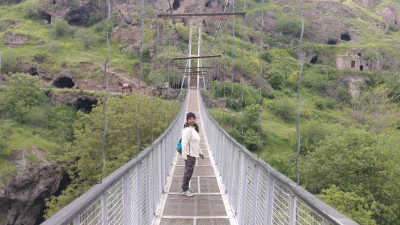
Afterwards, we drove to Khndzoresk to see its apparently famous swinging bridge across the gorge.
The turn-off to the suspension footbridge was clearly signposted from the main road, but from there the road was little more than a dirt track. A major tourist attraction without a proper road?
At the end was a sign for the parking area, although it was far from clear where exactly we were supposed to park.
It had rained earlier that day, so the ground was still wet and muddy. We parked close to what seemed to be the walking path down. The soil was full of clay and, within minutes, our shoes seemed to weigh a couple of kilos.
We became increasingly desperate not to slip.
We carefully continued, trying to keep to the edges of the path where the mud was slightly less treacherous. Eventually, we reached a point where a man indicated the entrance to the bridge. He also pointed out that we could have simply walked down the long staircase behind him from the parking area...The swinging bridge, KhndzoreskCrossing the swaying bridge provided sweeping views of the gorge. It hangs some 60 metres above the bottom and sways gently as you make your way across to the historic village on the other side.
We walked through the village and saw quite a few of its cave dwellings, as well as the 17th-century Hripsime Church.
It was fascinating to learn that this now-uninhabited village was only abandoned in the 1960s, when the Soviet authorities ordered its inhabitants to move elsewhere.
Standing inside the caves at times, it was hard to believe that people had lived here until so recently, especially when you consider the harsh winter conditions.
Day 6 - Down the Vorotan Gorge and the climb to Tatev 🚲
Depending on the weather, this was expected to become my last cycle ride in Armenia.
Luckily, it was sunny.
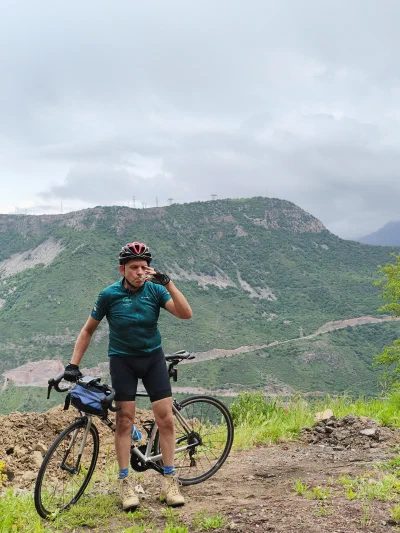
Mita dropped me off at the Goris Gate just out of town and the cycling began. It started with a climb of around 200 metres to reach the junction where we turned left towards Tatev.The climb to TatevWith my yellow windbreaker providing some extra visibility and protection against the cold - it was only 11°C - the descent was fast and enjoyable.
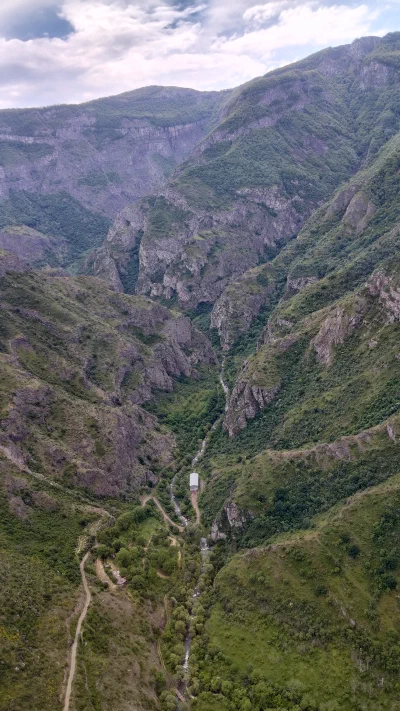
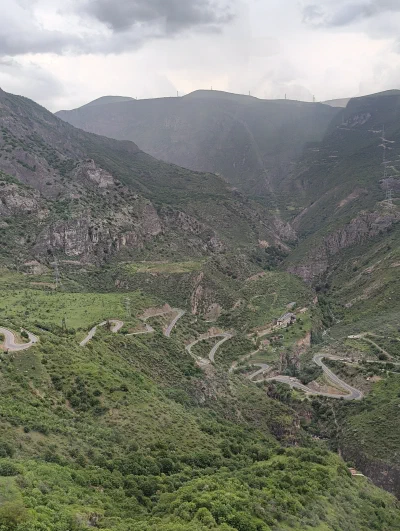
Riding down into the Vorotan Gorge was quite spectacular, although it required plenty of braking before each hairpin.My last gelAt the bottom of the gorge, the transition from descending to climbing came quickly. There were only about 50 metres of relatively flat road before the climb started.
One final intake of electrolytes and off we went.
The two videos speak for themselves. The twenty-odd hairpins were actually much appreciated, as each one provided a few seconds of respite before the next section of climbing.
Just as I reached Tatev, it started to drizzle. We headed off for a hot chocolate and somewhere dry to wait until we could check into our hotel for the next two nights.
Day 7 - Return to Yerevan 🚙
We needed to return the car to Yerevan in time.
To our surprise, we did not need to return via Goris but could head straight north. The road was in beautiful condition and full of gentle descents, and I felt genuinely sad not to be cycling it.
After all the climbing in southern Armenia, it would have been a rather nice way to finish the cycling.
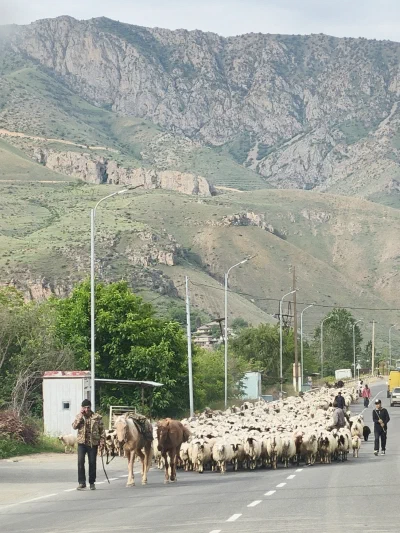
Sheep on the roadOur return to Yerevan
Once we reached Yerevan, we took the night train back to Tblisi to travel through Turkey. Sadly, the Armenia–Turkey 300km long land border has been closed mainly because of Turkey's support for Azerbaijan during the Nagorno-Karabakh conflict in 1993. Turkey continued denial of the Ottoman genocide in 1915 does not help the border reconciliation issue.
Loading comments...